Documenting my learning and inquiries!

Category: Reflections

Accessibility in Online Education and Spaces

Disclaimer

This post is based on my own research and understanding of accessibility in open/online education. We did not formally cover this topic in class, so I took the liberty to do some of my own research and share my findings!

Faculty Focus’ article “Enhancing Access, Engagement, and Inclusion in Online Education” draws on the rapid growth of online education and flexible learning. As we begin to transition away from traditional classrooms, it’s important to keep accessibility in mind.

Accessibility refers to removing barriers that prevent students from accessing course content and demonstrating learning in ways that align with their strengths. Having an accessible online learning platform means there is clear navigation and structure, assistive technology (screen readers, etc.), and diverse learning opportunities that allow different means of engagement and expression. Assistive tools, such as speech-to-text (and vice-versa) software, screen readers, and fonts, are important; however, how the instructor structures the course and interacts with students is a key component of accessible online learning. For example, offering flexible engagement options (synchronous and asynchronous participation) ensures that students in different time zones or with scheduling challenges can join discussions and activities. Course design and execution are foundational.

Engagement and community matter. Accessibility is not only about accessing materials, but also about feeling included and being able to participate meaningfully. Building a supportive online community fosters connection and reduces isolation. This can involve virtual mentorship or collaborative assignments that allow students to work together using accessible tools. Providing regular, constructive feedback reinforces student motivation and helps learners stay on track.

Accessibility is constantly evolving, and we are still finding ways to broaden access to learning.
WEEK 2 REFLECTION BLOG: Connecting Data Privacy to Health Informatics

Health informatics broadly refers to the use of information technology and data management methods in healthcare. For example, in storing and sharing electronic health records (EHRs), integrating data from wearable devices or telemedicine apps, supporting clinical decision making, enabling research, and more.

Data Privacy in Healthcare: Global Challenges and Solutions highlights how the digitization of healthcare has increased both the value and vulnerability of health data. Health informatics systems integrate identifying information with clinical details such as diagnoses, genetic data, mental health records, and treatment histories. Unauthorized access or data breaches can result in identity theft, discrimination, stigma, or psychological harm, making strong privacy protections ethically necessary rather than optional.

From an ethical perspective, data privacy in health informatics is closely tied to the principles of autonomy, beneficence, and justice. Respecting patient autonomy requires that individuals have meaningful control over how their data is collected, used, and shared. Many healthcare systems still lack transparent consent processes, especially when data is reused for research, artificial intelligence, or secondary analysis. This raises ethical concerns when patients are unaware of how their information circulates within or beyond health systems.

Accessibility is another critical part of data privacy in health informatics. Poorly designed privacy protections can unintentionally exclude or disadvantage certain populations. For example, complex consent forms or inaccessible patient portals may be difficult for people with disabilities, low health literacy or digital literacy, or language barriers to understand. This can prevent individuals from exercising informed consent over their own data.

Data privacy is not only a technical issue but a moral and social one that shapes how inclusive, fair, and effective health informatics systems can be.

WEEK 4 REFLECTION BLOG: Connectivism

What is Connectivism?

This week, we discussed the term connectivism.

Tony Bates’ textbook, “Teaching in a Digital Age,” describes connectivism as a new, evolving learning theory in the digital age of education. Connectivism primarily focuses on creating networks of connections (nodes) that foster knowledge.

Some of the principles of connectivism include:

  • Diverse opinions foster learning and knowledge.
  • Connecting nodes for learning and information.
  • Nurturing connections is crucial for learning.
  • Critical thinking and decision-making are part of learning. Opinions and knowledge shift and develop over time.

Connectivism Applications in Teaching and Learning

In connective learning, the instructor’s role is minimal. They set up the learning environment and guide learners through building their personal learning networks. In connective learning, learning is fostered by interactions, reflection, and exposure to information.

Connectivism does face some criticism with its vague teacher presence and large-scale learning; however, it is the first theory to rethink how learning happens in this digital era.

Summary and Personal Opinion

Connectivism is a modern learning and teaching approach in the digital age of learning, and it focuses on building connections and collaboration.

Personally, I tend to struggle without structure and support in my learning unless I’m completely infatuated with a subject. Although everyone is different, there is absolutely a place for connective learning. I do appreciate the flexibility and diverse approach.

WEEK 3 REFLECTION BLOG: Modality vs. Pedagogy

Week three covered a lot of interesting topics. I have chosen to document my notes and personal research on “Modality vs. Pedagogy,” more specifically, their main differences, and how they interact and relate to open education.

MODALITY:

Modality refers to how learning is distributed and the specific format/delivery. For example, learning can be face-to-face, fully online (synchronous or asynchronous), a mix of online/face-to-face, or distributed (students can access materials from differing locations, time zones, etc.)

PEDAGOGY:

Pedagogy refers to how learning is structured, taught, and assessed. This includes teaching philosophies and learning and assessment methods. For example, an instructor may choose to use a group discussion as a learning activity in order to help students grasp a new concept.

HOW DO MODALITY & PEDAGOGY INTERACT?

Modality sets the environment, and pedagogy determines the teaching and learning will actually flow within that environment.

A learning environment that respects both will be successful!

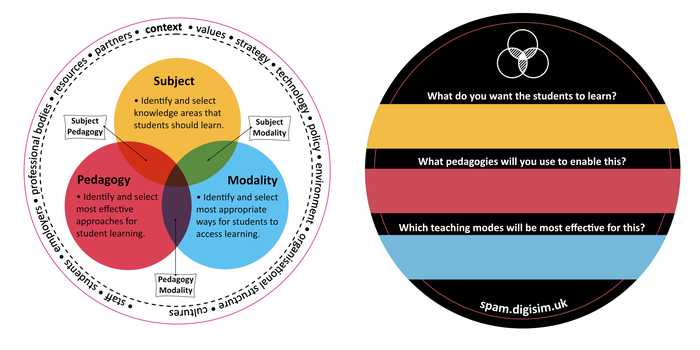
Here’s a great diagram on the intersection between Modality and Pedagogy!

two circles showing the crossovers between subject, pedagogy, and modality.

Image credit: Apple (n.d.)