Motivation plays a central role in students’ success in online learning environments, influencing not only their engagement but also their ability to self-regulate and complete courses successfully. The National Library of Medicine highlights how motivational strategies and self-regulation are essential components in online contexts where structure is limited compared to traditional classroom settings.
The article emphasizes that students in online programs who are successful tend to have stronger motivational strategies. These include setting personal goals and using learning strategies intentionally. Online environments challenge learners because of reduced social presence and reduced immediate feedback from instructors and classmates. Personally, I have come to recognize that I struggle with self-regulation and motivation in my schoolwork unless I have support and structure.
To help students, like myself, who struggle with motivation, instructors can create clear learning goals, offer consistent feedback, and allow students the opportunity to connect and work with their peers.
This is a super informative online conference with Deirdre Cjiffers, where they discussed keeping both students and teachers motivated through online learning.
Background
“Exploration of the Motivational Factors that Influence the Maintenance of Health” reports on a survey study investigating what motivates people to maintain positive health behaviours across diverse individuals. The authors collected data via a web-based survey of 204 participants aged 16 and older, measuring self-rated health, health habits, and various motivational factors for maintaining a healthy lifestyle. Findings include average motivation scores related to health, caregiving responsibilities, personal values, and external influences. The study also identified themes such as longevity, quality of life, family influences, independence, prevention of complications, personal goals, finances, and faith as common motivators for pursuing health maintenance.
One of the most interesting takeaways from the study is that people are rarely motivated by just one thing. Instead, health motivation tends to come from a mix of personal values, life circumstances, and external pressures. Participants frequently cited reasons like wanting a better quality of life, staying productive, being there for family, and maintaining independence as major drivers of their health behaviours.
Interestingly, external motivators, such as cultural expectations or societal pressures, tended to score lower overall. These extrinsic factors can influence behaviour; however, the study suggests they may not be as powerful or consistent as internal motivations.
The article makes a clear point that motivation relies on personal values and drive, and your internal motivation is often what sparks change.
Disclaimer
This post is based on my own research and understanding of accessibility in open/online education. We did not formally cover this topic in class, so I took the liberty to do some of my own research and share my findings!
Faculty Focus’ article “Enhancing Access, Engagement, and Inclusion in Online Education” draws on the rapid growth of online education and flexible learning. As we begin to transition away from traditional classrooms, it’s important to keep accessibility in mind.
Accessibility refers to removing barriers that prevent students from accessing course content and demonstrating learning in ways that align with their strengths. Having an accessible online learning platform means there is clear navigation and structure, assistive technology (screen readers, etc.), and diverse learning opportunities that allow different means of engagement and expression. Assistive tools, such as speech-to-text (and vice-versa) software, screen readers, and fonts, are important; however, how the instructor structures the course and interacts with students is a key component of accessible online learning. For example, offering flexible engagement options (synchronous and asynchronous participation) ensures that students in different time zones or with scheduling challenges can join discussions and activities. Course design and execution are foundational.
Engagement and community matter. Accessibility is not only about accessing materials, but also about feeling included and being able to participate meaningfully. Building a supportive online community fosters connection and reduces isolation. This can involve virtual mentorship or collaborative assignments that allow students to work together using accessible tools. Providing regular, constructive feedback reinforces student motivation and helps learners stay on track.
Accessibility is constantly evolving, and we are still finding ways to broaden access to learning.
Psychological research increasingly shows that successful behaviour change cannot be explained by knowledge or willpower alone. Instead, motivation is shaped by a complex interaction of cognitive, emotional, and automatic processes.
Traditional models of behaviour change often highlight reflective motivation. These models assume that people change behaviour by weighing pros and cons, setting goals, building self-efficacy, and forming intentions. While these factors are important, particularly during early stages such as awareness and planning, they do not fully explain why people struggle to maintain new behaviours long term. Motivation is not static, and conscious decision-making is vulnerable to stress, fatigue, and other priorities.
Motivation can be understood through different states. One is approach-oriented motivation, where individuals are drawn toward activities they expect will be pleasurable or beneficial. For example, someone may begin exercising because they enjoy how it makes them feel or because it offers immediate positive feedback. Another state is avoidance-oriented motivation, where behaviour is driven by a desire to escape discomfort, guilt, or negative health consequences. Although this type of motivation can prompt change, it is often less sustainable if not paired with positive reinforcement.
Over time, as behaviours are repeated, motivation may shift again. Instead of actively “wanting” or “avoiding,” individuals may enter a maintenance state in which the behaviour feels natural and stable. At this point, the behaviour no longer requires constant conscious motivation or reward anticipation; it becomes habitual. This aligns with psychological theories of habit formation and automaticity, where context and routine guide behaviour more than deliberate choice.
Understanding these motivational phases has important implications for designing effective behaviour change strategies. Different techniques are useful at different stages. Early change may benefit from motivational boosts that create positive emotional experiences or reduce perceived effort. Later stages may require environmental supports and cues that reinforce habits without demanding ongoing self-control. Strategies that appeal only to reasoning or information may fail if they do not also engage emotional and automatic motivational systems.
Recognizing these dynamics helps explain why behaviour change is difficult, but also how it can be made more effective and sustainable.
Heres a great TED Talk I found discussing rewards and motivation!
Health informatics broadly refers to the use of information technology and data management methods in healthcare. For example, in storing and sharing electronic health records (EHRs), integrating data from wearable devices or telemedicine apps, supporting clinical decision making, enabling research, and more.
Data Privacy in Healthcare: Global Challenges and Solutions highlights how the digitization of healthcare has increased both the value and vulnerability of health data. Health informatics systems integrate identifying information with clinical details such as diagnoses, genetic data, mental health records, and treatment histories. Unauthorized access or data breaches can result in identity theft, discrimination, stigma, or psychological harm, making strong privacy protections ethically necessary rather than optional.
From an ethical perspective, data privacy in health informatics is closely tied to the principles of autonomy, beneficence, and justice. Respecting patient autonomy requires that individuals have meaningful control over how their data is collected, used, and shared. Many healthcare systems still lack transparent consent processes, especially when data is reused for research, artificial intelligence, or secondary analysis. This raises ethical concerns when patients are unaware of how their information circulates within or beyond health systems.
Accessibility is another critical part of data privacy in health informatics. Poorly designed privacy protections can unintentionally exclude or disadvantage certain populations. For example, complex consent forms or inaccessible patient portals may be difficult for people with disabilities, low health literacy or digital literacy, or language barriers to understand. This can prevent individuals from exercising informed consent over their own data.
Data privacy is not only a technical issue but a moral and social one that shapes how inclusive, fair, and effective health informatics systems can be.
Hi, I’m Chanelle
I’m a second-year Health Information Science student. I live on a farm in beautiful Brentwood Bay with three horses, three sheep, and lots of fruit trees and other produce. I love animals, listening to my favourite music, and going hiking in my free time.


I joined EDCI 339 as I was curious about remote learning and excited to take on a course at my own pace.
After reading Kendra Cherry’s article, “Motivation: The Driving Force Behind Our Actions“, I was inspired to create a small blog post on the different types of motivation.
Extrinsic Motivation:
Extrinsic motivation is derived from external sources, such as praise, income, or a title.
Intrinsic Motivation:
Intrinsic motivation is a personal motivation that comes from within an individual, for example doing something because it’s satisfying or feels rewarding.
Why is Motivation Important?
Motivation increases your drive to take action and complete goals efficiently. Motivation is a driving force in caring for your physical and mental health, and it helps you feel a sense of control in your life.
Motivation is also a huge factor in happiness and overall well-being.
Factors that can cause Low Motivation:
- Being obsessed with perfection and having an all-or-nothing mindset.
- Mental health conditions such as depression.
- Always expecting immediate results and losing motivation when you aren’t achieving your goals as quickly as you expected.
Key Takeaways:
- There are many driving forces behind motivation, and it is extremely complex and individual from person to person.
- Understanding how your own motivation thrives is the key to success.
What is Connectivism?
This week, we discussed the term connectivism.
Tony Bates’ textbook, “Teaching in a Digital Age,” describes connectivism as a new, evolving learning theory in the digital age of education. Connectivism primarily focuses on creating networks of connections (nodes) that foster knowledge.
Some of the principles of connectivism include:
- Diverse opinions foster learning and knowledge.
- Connecting nodes for learning and information.
- Nurturing connections is crucial for learning.
- Critical thinking and decision-making are part of learning. Opinions and knowledge shift and develop over time.
Connectivism Applications in Teaching and Learning
In connective learning, the instructor’s role is minimal. They set up the learning environment and guide learners through building their personal learning networks. In connective learning, learning is fostered by interactions, reflection, and exposure to information.
Connectivism does face some criticism with its vague teacher presence and large-scale learning; however, it is the first theory to rethink how learning happens in this digital era.
Summary and Personal Opinion
Connectivism is a modern learning and teaching approach in the digital age of learning, and it focuses on building connections and collaboration.
Personally, I tend to struggle without structure and support in my learning unless I’m completely infatuated with a subject. Although everyone is different, there is absolutely a place for connective learning. I do appreciate the flexibility and diverse approach.
Week three covered a lot of interesting topics. I have chosen to document my notes and personal research on “Modality vs. Pedagogy,” more specifically, their main differences, and how they interact and relate to open education.
MODALITY:
Modality refers to how learning is distributed and the specific format/delivery. For example, learning can be face-to-face, fully online (synchronous or asynchronous), a mix of online/face-to-face, or distributed (students can access materials from differing locations, time zones, etc.)
PEDAGOGY:
Pedagogy refers to how learning is structured, taught, and assessed. This includes teaching philosophies and learning and assessment methods. For example, an instructor may choose to use a group discussion as a learning activity in order to help students grasp a new concept.
HOW DO MODALITY & PEDAGOGY INTERACT?
Modality sets the environment, and pedagogy determines the teaching and learning will actually flow within that environment.
A learning environment that respects both will be successful!
Here’s a great diagram on the intersection between Modality and Pedagogy!
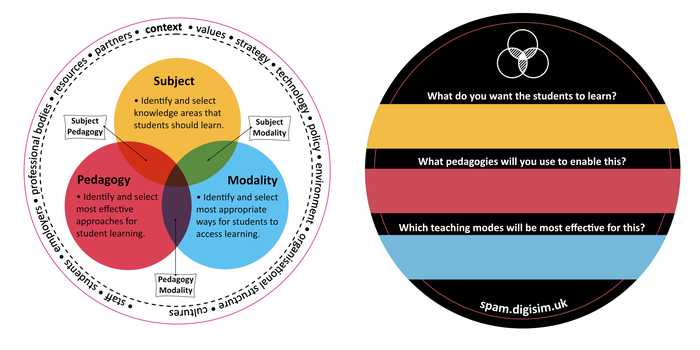
Image credit: Apple (n.d.)